lingscars marketing strategy
A Website That Shouldn’t Work
Management Today called it “the most cluttered website we’ve ever seen.” The Metro called it “quite possibly the worst and weirdest website on the internet.” The Independent called it “one of the best websites ever made.” We call Lingscars Marketing Strategy Genius in disguise.
They were all talking about the same site: LingsCars.com.
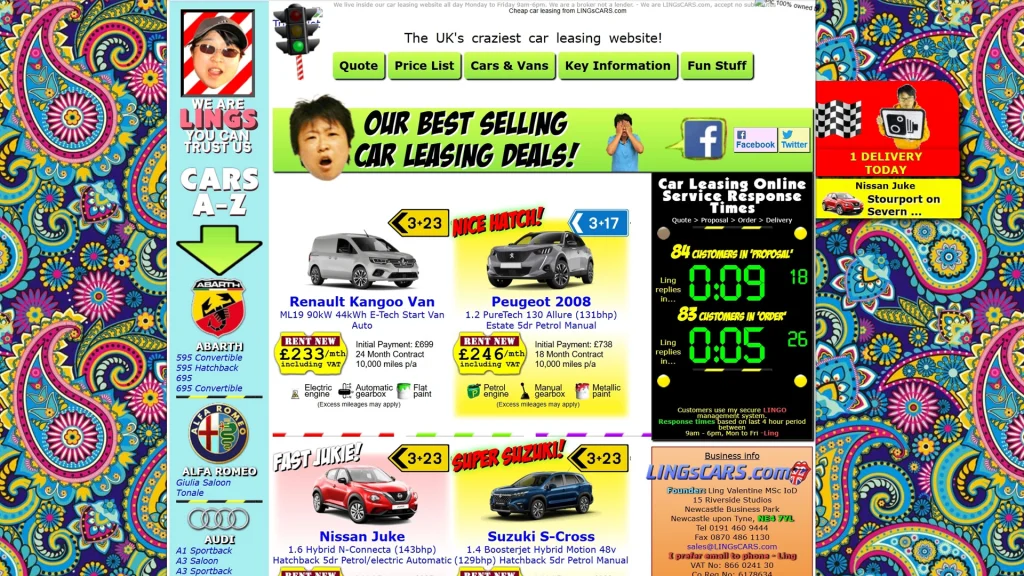
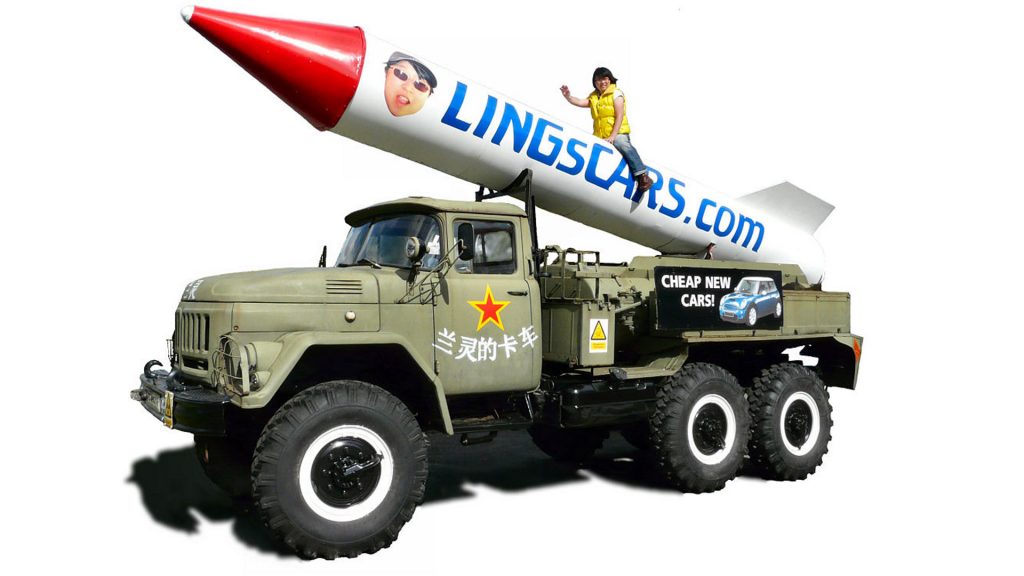
If you’ve never visited, picture a 90s fever dream crashing into a car dealership. Animated GIFs everywhere. Clashing colour palettes. Automatically playing music. A fully branded replica nuclear missile truck parked outside the office. Even the HTML source code contained a fully drawn ASCII portrait of Ling’s face buried in the comments. Another designer showed me that one years ago and it blew my mind. Who does that? Who puts that level of fanatical detail into something 99.9% of visitors will never see? Someone who genuinely loves what they’re building, that’s who.
And yet this garish, borderline offensive website was turning over tens of millions of pounds a year. No showroom. No physical stock. No conventional marketing budget. Just pure, unfiltered personality delivered through a browser.
LingsCars is one of the most fascinating case studies in digital marketing. Not because it followed the rules, but because it broke every single one of them and made more money doing it.
Who Is Ling Valentine?
Ling Valentine is a Chinese-born entrepreneur who moved to the UK in the 1990s after completing a BSc in Applied Chemistry. She founded LingsCars in 2000 with her husband Jon, running it out of their living room.
The business model was simple: 100% online car leasing, no showroom, no physical stock. Pure digital affiliate sales. As a digital pioneer, Ling achieved her success without ever touching a single car.
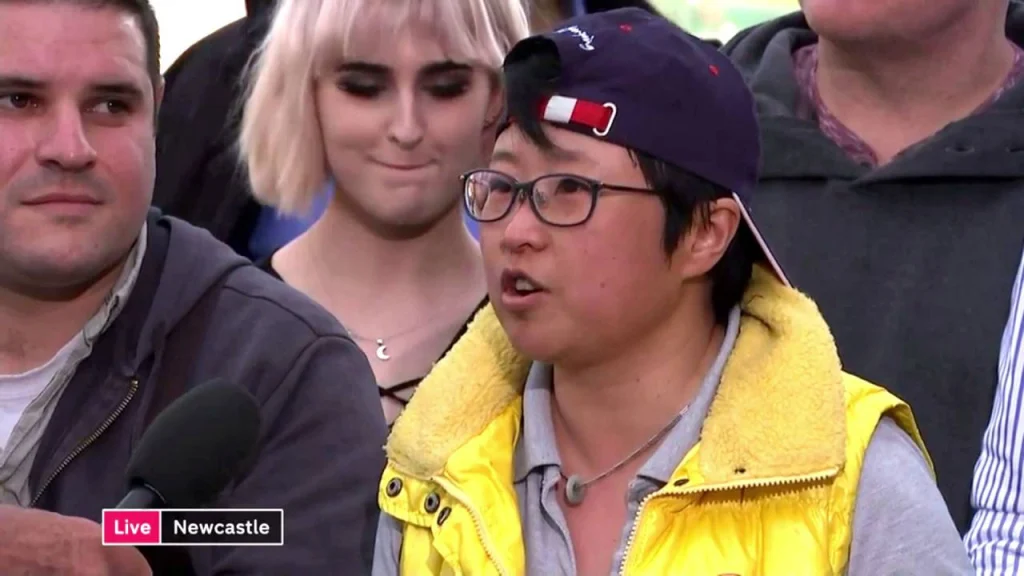
By 2006, the company was doing over £1 million a month in sales. Ling had built one of the most profitable car leasing operations in the country from a living room in Gateshead.
In 2007, Ling appeared on BBC’s Dragons’ Den. Her performance became one of the show’s most memorable moments. She received an offer from Duncan Bannatyne but turned it down because she “didn’t need his money”. Years later, she drove a branded yellow tank up to Bannatyne to demonstrate just how well things had gone without him. When Bannatyne attempted to question her figures, Ling’s accountant confirmed every number was accurate.
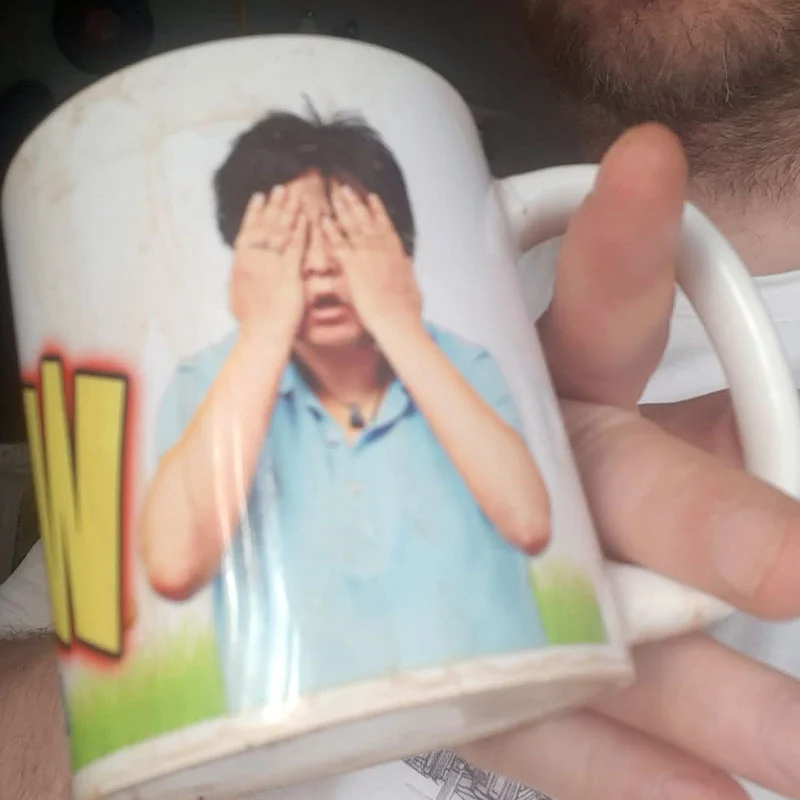
She once sent me two mugs. One said “Trendjackers Rocks.” The other said “Trendjackers Sucks.” I’m drinking from one of them right now. That’s Ling in a nutshell. She’ll give you both sides and let you decide.
The Anti-Design Tradition That Nobody Talks About
Here’s where most articles about LingsCars get it completely wrong. They frame the website as “crazy” or “accidental” or “so bad it’s good.” As if Ling just happened to stumble into a design language that worked despite itself.
If you grew up on the internet in the late 90s and early 2000s, LingsCars doesn’t look crazy at all.
It looks like home.
It looks like Newgrounds at midnight, discovering some unhinged Flash animation that had no right to exist.
It looks like Myspace at 2am when you’re customising your profile for the sixth time that week, adding another auto-playing song and a tiled background that makes the text unreadable. It looks like the maximalist, personality-first web design that existed before the industry decided everything had to look like a Squarespace template.
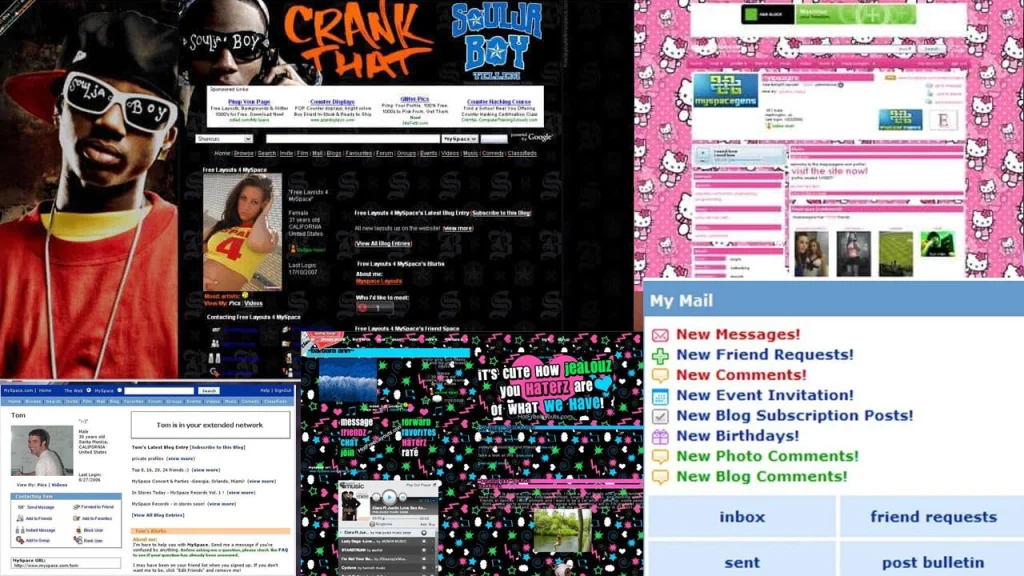
There’s a serious design lineage here that nobody in the marketing press connects to LingsCars because most marketing writers don’t know it exists.
The Designers Republic, Wipeout, and the Art of Visual Overload
Introducing The Designers Republic, the Sheffield studio that created the visual identity for Wipeout on PlayStation. tDR’s whole philosophy was about information overload as an aesthetic choice: dense, layered, chaotic, but absolutely intentional. Every texture, every overlapping element, every piece of visual noise was a decision.
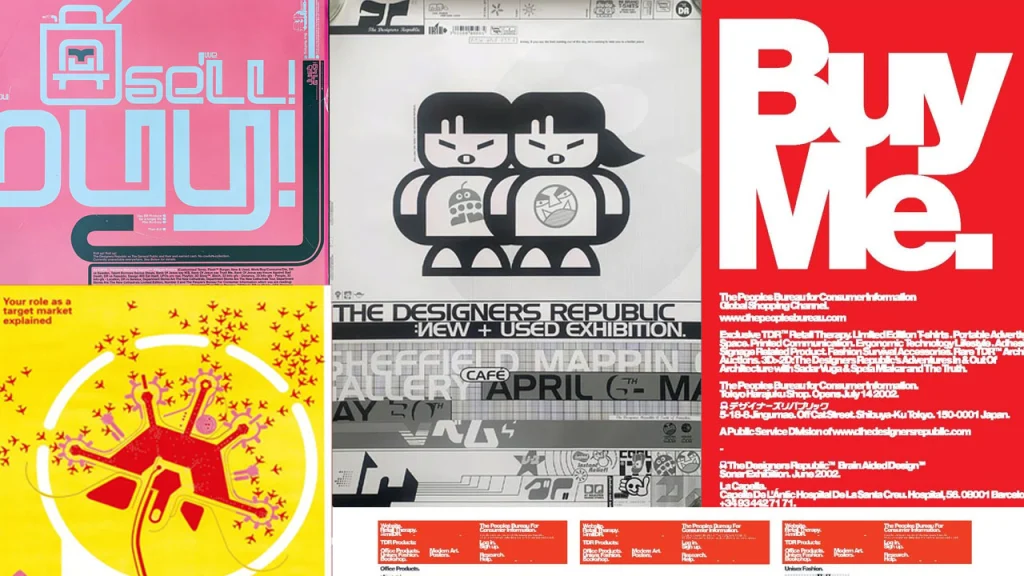
Think about the visual world of Aphex Twin and the Warp Records catalogue. Album art that looked like corrupted data rendered as graphic design. Rave flyers that crammed 400 words, 15 DJs, and a pixelated alien onto a single A5 sheet.
Jungle and drum and bass event posters that treated negative space as an enemy to be conquered.
This wasn’t “bad design.” It was a deliberate rejection of clean, corporate, Swiss-minimalist design principles in favour of something that felt alive and human and slightly unhinged.
We even see this in video games like Jet Set Radio, Viewtiful Joe and Persona 5, which shipped in 2016 with the most aggressively stylised UI in gaming history and proved that information-dense, maximalist interfaces could be more usable and more memorable than minimalist ones, not less.
Is Minimalism A Western Bias?
Something I’ve been thinking about for years is whether the design industry’s obsession with minimalism is actually a bias rather than a universal truth.
We treat Swiss-style grid design and Scandinavian minimalism as if they’re the objectively “correct” way to design things. Clean lines, white space, restrained typography. If it doesn’t look like a Dieter Rams product, it’s “bad design.” But that’s one cultural perspective, not a law of physics.
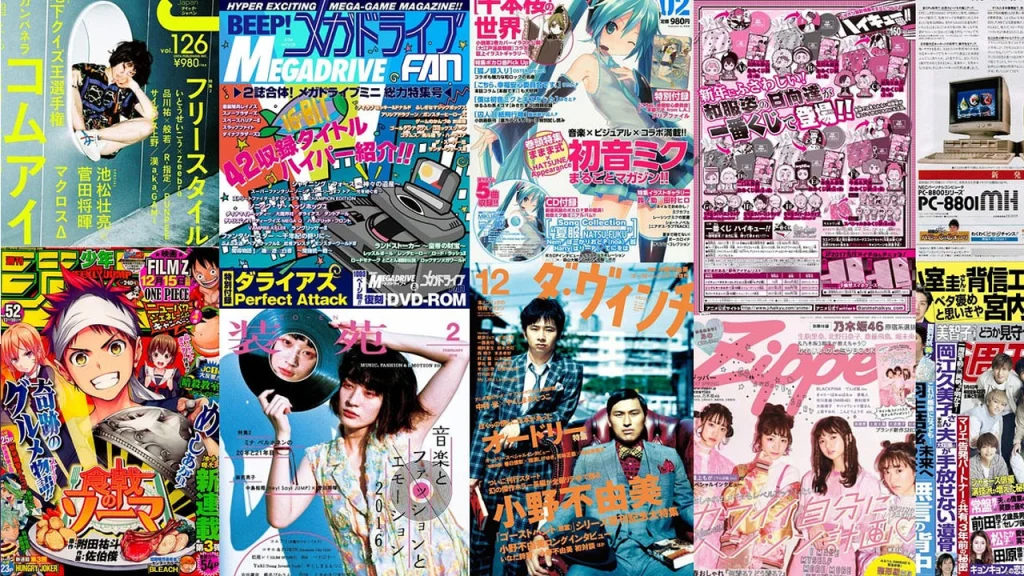
Spend any time looking at web design across East Asia and you’ll see completely different philosophies at work. Japanese websites are often packed with information, dense navigation, and small graphical flourishes that a Western designer would strip out immediately.
Korean web design (and I’ve seen this firsthand building the Korea Foods website) tends towards bolder, more visually saturated layouts than a typical UK agency would ever recommend. Chinese e-commerce platforms like Taobao make Amazon look like a minimalist art gallery.
Now, I want to be careful here, I’m not trying to lump vastly different cultures together under one label.
But there is a broader observation worth making: the idea that “less is more” is not a universal truth.
Different visual cultures have different relationships with density, colour, and information.
Ling Valentine had no formal design training and no respect for the conventions of the automotive industry.
So she built something that felt authentic to her rather than copying the template everyone else was using.
The result looks nothing like a car dealership website.
That was the whole point.
The Personality Cult: Ling’s Social Media Was Never About Cars
If you look at Ling’s YouTube channel, you’ll notice something immediately. Most car dealership channels post walkaround videos, test drives, and promotional clips. Ling posted music videos.
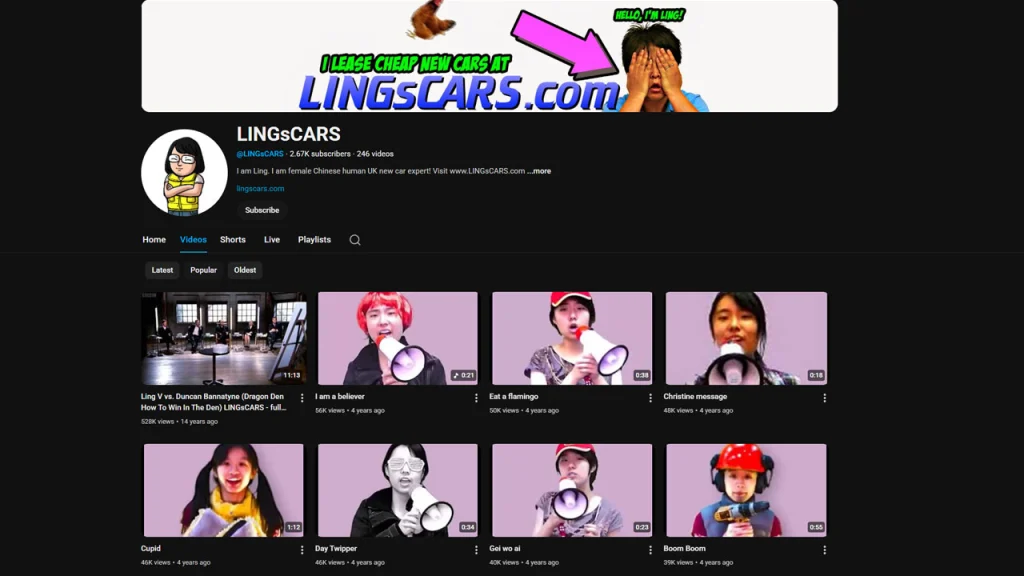
Ling built what you might call a micro-celebrity personality cult. Her social media was about Ling the character, not LingsCars the business. The cars were almost incidental.
You followed Ling because she was entertaining, and then when you needed to lease a car, who were you going to call?
The faceless corporate dealership down the road, or the woman who sent you branded noodles and made you watch a video called “Yummy Yummy I Got Love In My Tummy”?
This is something that modern “personal branding” advice completely misunderstands.
Everyone tells you to “build a personal brand” but what they usually mean is “post LinkedIn thought leadership about your industry.”
Ling didn’t do that.
She built an actual personality-driven media brand that happened to sell cars.
The content wasn’t “about” car leasing.
The content was about being Ling.
So in her next move, she went on to park a nuclear missile truck alongside the A1 motorway until the council forced her to move it.
Chaos By Design: The Backend Nobody Saw
It’s tempting to look at LingsCars.com and assume there was no strategy behind the chaos. That would be a mistake.
Ling was a strong advocate of heatmaps and A/B testing, as shown in her talks at marketing conferences.
While the site looked anarchic, the conversion paths were carefully monitored and optimised.
The wild design got people through the door. The backend data made sure they converted.
Her custom CRM system, called LINGO, allowed two people to manage a pipeline of up to 300 customers at a time. Every customer conversation was fully transcribed and saved in an uneditable format. Computer Shopper magazine saw the system in action and said: “Welcome to the future.”
At a time when most dealerships were still using pen and paper, LingsCars was running a fully integrated digital operation behind the curtain of chaos. Ling preferred digital methods over face-to-face meetings specifically because everything could be logged, tracked, and processed efficiently.
The chaotic website was the front door.
Behind it sat one of the most data-driven small businesses in the UK automotive sector.
LingsCars wasn’t chaos. It was ordered entirely differently.
What Happened When Ling Left
In October 2020, Ling announced her retirement from the motor industry, planning to cycle around the world. Her staff took over the business. In February 2025, the website was redesigned, removing many of the animated elements and subduing the layout.
A preserved version of the original site now lives at museum.lingscars.com.
From a technical standpoint, the results were immediate. Organic search visibility improved dramatically.
The old site was genuinely difficult for Google: slow load speeds, confusing UX, poor mobile experience, no structured data. The new version fixed all of that.
But the redesign also raises a question that I find genuinely interesting. The original LingsCars website wasn’t just a website. It was an experience, a destination, an internet artifact that people visited for entertainment with zero intention of buying a car.
I used to go back for days, just exploring, finding new easter eggs and hidden sections. You lose something real when you clean that up, even if the conversion metrics improve. The museum preservation was a smart move, and the new site still has more personality than 99% of its competitors. But anyone who spent serious time on the original knows it’s a different thing now.
The bigger challenge was the brand identity itself. LingsCars was a founder-led brand in the purest sense. Ling’s face was on every page. Her personality drove the content. Her voice was in every piece of marketing. When she left, the brand risked losing the very thing that made it special.
The solution? Turn Ling into a mascot.
The new ownership commissioned a modular character illustration system that captures Ling’s likeness and personality: the crossed arms, the hi vis vest, the nuclear truck. The mascot now appears across the LingsCars website and social media, producing daily content through a “Build Your Own Ling” system of swappable outfits and accessories for every season and occasion.
Read the full case study on how we designed the LingsCars mascot →
The Trendjackers Connection (And The Shadow Agency It Spawned)
I have a long history with this brand. Before Trendjackers existed, I worked at an automotive marketing agency where everyone dismissed Ling’s approach. They looked at the website and saw mess. I looked at the revenue and saw a masterclass.
Ling’s philosophy was a massive inspiration for starting Trendjackers. Years later, I reached out to interview her, which turned into an in-depth feature article and video that became one of the most shared pieces on this site. I also wrote about brutalist web design using LingsCars as a centrepiece example.
When Ling retired and the business changed hands, the new owners tracked me down. Not through an ad, not through a referral. They found the content I’d created and decided I was the right person to handle the brand’s visual identity going forward. If that’s not proof that content marketing works, I don’t know what is.
If you’re interested in the design process, the concept sketches, and how the modular character system works, the full case study is here.
But Ling’s influence went further than client work. Watching her checkmate every suit-and-tie-wearing corporate normie in the automotive industry by simply being more entertaining than them planted a different seed entirely.
I’d spent years in meetings about meetings. Reverse proxy API KPI nonsense. The kind of startup culture where everyone uses words like “synergy” and “leverage” without irony and nobody ever actually makes anything. I watched people who couldn’t design a business card lecture rooms full of people about “disruption.” And I thought: what if the villain version of these people had their own company?
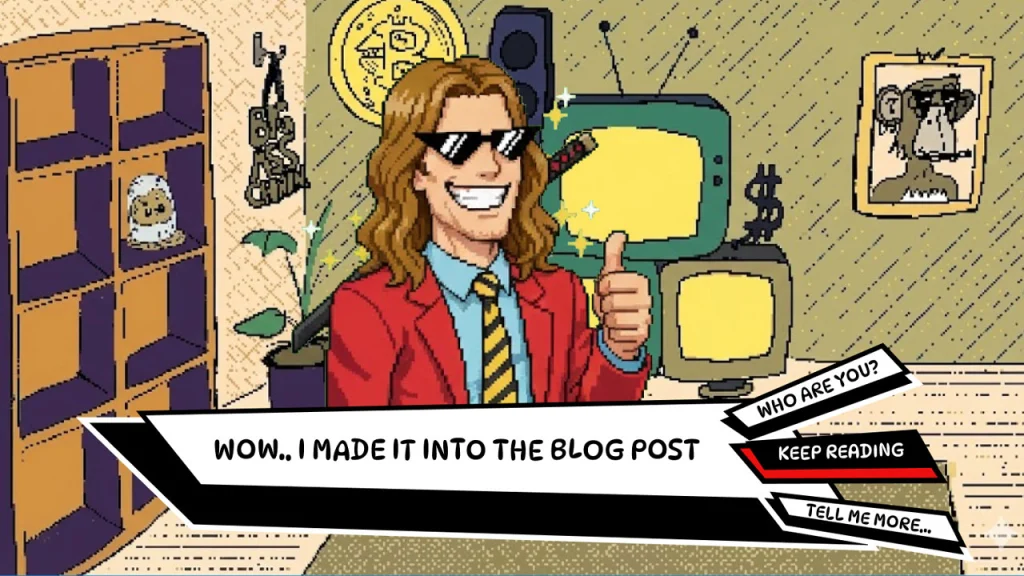
That’s how Wacky Scam Warehouse was born. WSW is a business art movement that does basically nothing. Its CEO, the enigmatic William Wacky, is a red-suited, sunglasses-wearing charismatic con man who employs every dark hat marketing tactic in the book: predatory pricing, loot crates, ads that feel a little too personal. But they always get him into trouble. He’s the Jungian shadow of a legitimate marketing agency. Everything a real professional shouldn’t be, cranked to absurd levels.
The project spans video, game development, illustration, and a whole fictional universe. If Trendjackers is the professional side of what I do, WSW is the laboratory. The place where I test ideas, push visual boundaries, and make the kind of maximalist, personality-driven content that Ling pioneered, just pointed in a completely different direction. The philosophy connecting both of them traces directly back to watching Ling Valentine park a nuclear missile truck next to the A1 and thinking: I want one of those nukes!
The Contrarian Matrix: Why Running The Other Way Actually Works
There’s a formal framework for everything I’ve been describing in this article, and it comes from an unlikely source: LinkedIn’s B2B Institute.
Peter Weinberg and the team at LinkedIn’s think tank developed something called the Contrarian Matrix. The idea is simple. In any decision, you can be right or wrong, and you can be with the crowd or against it. That gives you four quadrants:
Consensus and wrong: You followed the herd and it didn’t work. Standard failure.
Consensus and right: You followed the herd and it worked, but so did everyone else. No competitive advantage. The value gets competed away.
Contrarian and wrong: You went against the grain and it didn’t work. Painful. Everyone hates you. You’re wrong.
Contrarian and right: You went against the grain and it worked. You alone capture all the upside. This is the only quadrant that creates real, durable competitive advantage.
Peter Thiel asks the same question from a different angle: “What important truth do very few people agree with you on?”
LingsCars lived in that fourth quadrant for over two decades. Every car dealership in the UK was consensus: clean website, corporate messaging, stock photography, play it safe. LingsCars was contrarian: chaotic website, personality-driven content, nuclear missile trucks, ASCII art in the source code. And she was right. Tens of millions a year, zero showroom, two person operation managing 300 customers through a custom CRM while the rest of the industry was still using paper forms.
The Designers Republic was contrarian and right. Aphex Twin was contrarian and right. Jet Set Radio was contrarian and right. Every example I’ve cited in this article shares the same structure: a market full of sameness, and one entity that decided to go the other way and had the conviction to commit fully.
This is the actual lesson of LingsCars. Not “be wacky.” Not “make your website ugly.” Not “copy what Ling did.” The lesson is: find the thing that everyone in your industry agrees on, examine whether that consensus is actually correct, and if it isn’t, have the guts to do the opposite.
Most people won’t. Most people will look at the field of brown cows and decide that brown must be the right colour. That’s fine. More room for the rest of us.
Frequently Asked Questions
Is LingsCars still in business?
Yes. Ling Valentine retired in October 2020, but the business continues under new ownership. The website was redesigned in February 2025, and a preserved version of the original site is available at museum.lingscars.com.
Why does the LingsCars website look so chaotic?
The design was deliberately chaotic. In a market full of identical corporate car dealership websites, LingsCars chose to stand out through personality and entertainment. There’s also a legitimate argument that the maximalist aesthetic draws from a design tradition (anti-corporate, information-dense, personality-first) that has a long history in visual culture, from The Designers Republic to East Asian web design.
How much money did LingsCars make?
By 2006, LingsCars was reported to be doing over £1 million a month in sales. The business has been widely reported to turn over tens of millions of pounds annually, all without a physical showroom.
Did LingsCars appear on Dragons’ Den?
Yes, in 2007. Ling Valentine received an offer from Duncan Bannatyne but turned it down. She later appeared in a follow-up programme where she drove a branded yellow tank to demonstrate the business’s continued success. She calculated the TV exposure was worth over £250,000 in equivalent advertising.
What happened to the original LingsCars website?
The original website was preserved and moved to museum.lingscars.com when the main site was redesigned in February 2025. The new lingscars.com performs significantly better for SEO, although it has a different feel from the original.
What is the LingsCars mascot?
Following Ling’s retirement, a modular mascot character was created to preserve the founder’s personality as a flexible brand asset. The mascot system includes swappable outfits and accessories, allowing the team to produce ongoing branded content without needing the founder present. See the full mascot design case study.
What is the Contrarian Matrix?
The Contrarian Matrix is a framework from LinkedIn’s B2B Institute that maps decisions along two axes: right/wrong and consensus/contrarian. The key insight is that being consensus and right creates no competitive advantage because everyone captures the same value. Only being contrarian and right creates durable competitive advantage.
★ Need a website, brand identity, or creative strategy that actually stands out? ★
No contracts. No jargon. Just results.
Comments

lingscars marketing strategy
A Website That Shouldn’t Work
Management Today called it “the most cluttered website we’ve ever seen.” The Metro called it “quite possibly the worst and weirdest website on the internet.” The Independent called it “one of the best websites ever made.” We call Lingscars Marketing Strategy Genius in disguise.
They were all talking about the same site: LingsCars.com.
If you’ve never visited, picture a 90s fever dream crashing into a car dealership. Animated GIFs everywhere. Clashing colour palettes. Automatically playing music. A fully branded replica nuclear missile truck parked outside the office. Even the HTML source code contained a fully drawn ASCII portrait of Ling’s face buried in the comments. Another designer showed me that one years ago and it blew my mind. Who does that? Who puts that level of fanatical detail into something 99.9% of visitors will never see? Someone who genuinely loves what they’re building, that’s who.
And yet this garish, borderline offensive website was turning over tens of millions of pounds a year. No showroom. No physical stock. No conventional marketing budget. Just pure, unfiltered personality delivered through a browser.
LingsCars is one of the most fascinating case studies in digital marketing. Not because it followed the rules, but because it broke every single one of them and made more money doing it.
Who Is Ling Valentine?
Ling Valentine is a Chinese-born entrepreneur who moved to the UK in the 1990s after completing a BSc in Applied Chemistry. She founded LingsCars in 2000 with her husband Jon, running it out of their living room.
The business model was simple: 100% online car leasing, no showroom, no physical stock. Pure digital affiliate sales. As a digital pioneer, Ling achieved her success without ever touching a single car.
By 2006, the company was doing over £1 million a month in sales. Ling had built one of the most profitable car leasing operations in the country from a living room in Gateshead.
In 2007, Ling appeared on BBC’s Dragons’ Den. Her performance became one of the show’s most memorable moments. She received an offer from Duncan Bannatyne but turned it down because she “didn’t need his money”. Years later, she drove a branded yellow tank up to Bannatyne to demonstrate just how well things had gone without him. When Bannatyne attempted to question her figures, Ling’s accountant confirmed every number was accurate.
She once sent me two mugs. One said “Trendjackers Rocks.” The other said “Trendjackers Sucks.” I’m drinking from one of them right now. That’s Ling in a nutshell. She’ll give you both sides and let you decide.
The Anti-Design Tradition That Nobody Talks About
Here’s where most articles about LingsCars get it completely wrong. They frame the website as “crazy” or “accidental” or “so bad it’s good.” As if Ling just happened to stumble into a design language that worked despite itself.
If you grew up on the internet in the late 90s and early 2000s, LingsCars doesn’t look crazy at all.
It looks like home.
It looks like Newgrounds at midnight, discovering some unhinged Flash animation that had no right to exist.
It looks like Myspace at 2am when you’re customising your profile for the sixth time that week, adding another auto-playing song and a tiled background that makes the text unreadable. It looks like the maximalist, personality-first web design that existed before the industry decided everything had to look like a Squarespace template.
There’s a serious design lineage here that nobody in the marketing press connects to LingsCars because most marketing writers don’t know it exists.
The Designers Republic, Wipeout, and the Art of Visual Overload
Introducing The Designers Republic, the Sheffield studio that created the visual identity for Wipeout on PlayStation. tDR’s whole philosophy was about information overload as an aesthetic choice: dense, layered, chaotic, but absolutely intentional. Every texture, every overlapping element, every piece of visual noise was a decision.
Think about the visual world of Aphex Twin and the Warp Records catalogue. Album art that looked like corrupted data rendered as graphic design. Rave flyers that crammed 400 words, 15 DJs, and a pixelated alien onto a single A5 sheet.
Jungle and drum and bass event posters that treated negative space as an enemy to be conquered.
This wasn’t “bad design.” It was a deliberate rejection of clean, corporate, Swiss-minimalist design principles in favour of something that felt alive and human and slightly unhinged.
We even see this in video games like Jet Set Radio, Viewtiful Joe and Persona 5, which shipped in 2016 with the most aggressively stylised UI in gaming history and proved that information-dense, maximalist interfaces could be more usable and more memorable than minimalist ones, not less.
Is Minimalism A Western Bias?
Something I’ve been thinking about for years is whether the design industry’s obsession with minimalism is actually a bias rather than a universal truth.
We treat Swiss-style grid design and Scandinavian minimalism as if they’re the objectively “correct” way to design things. Clean lines, white space, restrained typography. If it doesn’t look like a Dieter Rams product, it’s “bad design.” But that’s one cultural perspective, not a law of physics.
Spend any time looking at web design across East Asia and you’ll see completely different philosophies at work. Japanese websites are often packed with information, dense navigation, and small graphical flourishes that a Western designer would strip out immediately.
Korean web design (and I’ve seen this firsthand building the Korea Foods website) tends towards bolder, more visually saturated layouts than a typical UK agency would ever recommend. Chinese e-commerce platforms like Taobao make Amazon look like a minimalist art gallery.
Now, I want to be careful here, I’m not trying to lump vastly different cultures together under one label.
But there is a broader observation worth making: the idea that “less is more” is not a universal truth.
Different visual cultures have different relationships with density, colour, and information.
Ling Valentine had no formal design training and no respect for the conventions of the automotive industry.
So she built something that felt authentic to her rather than copying the template everyone else was using.
The result looks nothing like a car dealership website.
That was the whole point.
The Personality Cult: Ling’s Social Media Was Never About Cars
If you look at Ling’s YouTube channel, you’ll notice something immediately. Most car dealership channels post walkaround videos, test drives, and promotional clips. Ling posted music videos.
Ling built what you might call a micro-celebrity personality cult. Her social media was about Ling the character, not LingsCars the business. The cars were almost incidental.
You followed Ling because she was entertaining, and then when you needed to lease a car, who were you going to call?
The faceless corporate dealership down the road, or the woman who sent you branded noodles and made you watch a video called “Yummy Yummy I Got Love In My Tummy”?
This is something that modern “personal branding” advice completely misunderstands.
Everyone tells you to “build a personal brand” but what they usually mean is “post LinkedIn thought leadership about your industry.”
Ling didn’t do that.
She built an actual personality-driven media brand that happened to sell cars.
The content wasn’t “about” car leasing.
The content was about being Ling.
So in her next move, she went on to park a nuclear missile truck alongside the A1 motorway until the council forced her to move it.
Chaos By Design: The Backend Nobody Saw
It’s tempting to look at LingsCars.com and assume there was no strategy behind the chaos. That would be a mistake.
Ling was a strong advocate of heatmaps and A/B testing, as shown in her talks at marketing conferences.
While the site looked anarchic, the conversion paths were carefully monitored and optimised.
The wild design got people through the door. The backend data made sure they converted.
Her custom CRM system, called LINGO, allowed two people to manage a pipeline of up to 300 customers at a time. Every customer conversation was fully transcribed and saved in an uneditable format. Computer Shopper magazine saw the system in action and said: “Welcome to the future.”
At a time when most dealerships were still using pen and paper, LingsCars was running a fully integrated digital operation behind the curtain of chaos. Ling preferred digital methods over face-to-face meetings specifically because everything could be logged, tracked, and processed efficiently.
The chaotic website was the front door.
Behind it sat one of the most data-driven small businesses in the UK automotive sector.
LingsCars wasn’t chaos. It was ordered entirely differently.
What Happened When Ling Left
In October 2020, Ling announced her retirement from the motor industry, planning to cycle around the world. Her staff took over the business. In February 2025, the website was redesigned, removing many of the animated elements and subduing the layout.
A preserved version of the original site now lives at museum.lingscars.com.
From a technical standpoint, the results were immediate. Organic search visibility improved dramatically.
The old site was genuinely difficult for Google: slow load speeds, confusing UX, poor mobile experience, no structured data. The new version fixed all of that.
But the redesign also raises a question that I find genuinely interesting. The original LingsCars website wasn’t just a website. It was an experience, a destination, an internet artifact that people visited for entertainment with zero intention of buying a car.
I used to go back for days, just exploring, finding new easter eggs and hidden sections. You lose something real when you clean that up, even if the conversion metrics improve. The museum preservation was a smart move, and the new site still has more personality than 99% of its competitors. But anyone who spent serious time on the original knows it’s a different thing now.
The bigger challenge was the brand identity itself. LingsCars was a founder-led brand in the purest sense. Ling’s face was on every page. Her personality drove the content. Her voice was in every piece of marketing. When she left, the brand risked losing the very thing that made it special.
The solution? Turn Ling into a mascot.
The new ownership commissioned a modular character illustration system that captures Ling’s likeness and personality: the crossed arms, the hi vis vest, the nuclear truck. The mascot now appears across the LingsCars website and social media, producing daily content through a “Build Your Own Ling” system of swappable outfits and accessories for every season and occasion.
Read the full case study on how we designed the LingsCars mascot →
The Trendjackers Connection (And The Shadow Agency It Spawned)
I have a long history with this brand. Before Trendjackers existed, I worked at an automotive marketing agency where everyone dismissed Ling’s approach. They looked at the website and saw mess. I looked at the revenue and saw a masterclass.
Ling’s philosophy was a massive inspiration for starting Trendjackers. Years later, I reached out to interview her, which turned into an in-depth feature article and video that became one of the most shared pieces on this site. I also wrote about brutalist web design using LingsCars as a centrepiece example.
When Ling retired and the business changed hands, the new owners tracked me down. Not through an ad, not through a referral. They found the content I’d created and decided I was the right person to handle the brand’s visual identity going forward. If that’s not proof that content marketing works, I don’t know what is.
If you’re interested in the design process, the concept sketches, and how the modular character system works, the full case study is here.
But Ling’s influence went further than client work. Watching her checkmate every suit-and-tie-wearing corporate normie in the automotive industry by simply being more entertaining than them planted a different seed entirely.
I’d spent years in meetings about meetings. Reverse proxy API KPI nonsense. The kind of startup culture where everyone uses words like “synergy” and “leverage” without irony and nobody ever actually makes anything. I watched people who couldn’t design a business card lecture rooms full of people about “disruption.” And I thought: what if the villain version of these people had their own company?
That’s how Wacky Scam Warehouse was born. WSW is a business art movement that does basically nothing. Its CEO, the enigmatic William Wacky, is a red-suited, sunglasses-wearing charismatic con man who employs every dark hat marketing tactic in the book: predatory pricing, loot crates, ads that feel a little too personal. But they always get him into trouble. He’s the Jungian shadow of a legitimate marketing agency. Everything a real professional shouldn’t be, cranked to absurd levels.
The project spans video, game development, illustration, and a whole fictional universe. If Trendjackers is the professional side of what I do, WSW is the laboratory. The place where I test ideas, push visual boundaries, and make the kind of maximalist, personality-driven content that Ling pioneered, just pointed in a completely different direction. The philosophy connecting both of them traces directly back to watching Ling Valentine park a nuclear missile truck next to the A1 and thinking: I want one of those nukes!
The Contrarian Matrix: Why Running The Other Way Actually Works
There’s a formal framework for everything I’ve been describing in this article, and it comes from an unlikely source: LinkedIn’s B2B Institute.
Peter Weinberg and the team at LinkedIn’s think tank developed something called the Contrarian Matrix. The idea is simple. In any decision, you can be right or wrong, and you can be with the crowd or against it. That gives you four quadrants:
Consensus and wrong: You followed the herd and it didn’t work. Standard failure.
Consensus and right: You followed the herd and it worked, but so did everyone else. No competitive advantage. The value gets competed away.
Contrarian and wrong: You went against the grain and it didn’t work. Painful. Everyone hates you. You’re wrong.
Contrarian and right: You went against the grain and it worked. You alone capture all the upside. This is the only quadrant that creates real, durable competitive advantage.
Peter Thiel asks the same question from a different angle: “What important truth do very few people agree with you on?”
LingsCars lived in that fourth quadrant for over two decades. Every car dealership in the UK was consensus: clean website, corporate messaging, stock photography, play it safe. LingsCars was contrarian: chaotic website, personality-driven content, nuclear missile trucks, ASCII art in the source code. And she was right. Tens of millions a year, zero showroom, two person operation managing 300 customers through a custom CRM while the rest of the industry was still using paper forms.
The Designers Republic was contrarian and right. Aphex Twin was contrarian and right. Jet Set Radio was contrarian and right. Every example I’ve cited in this article shares the same structure: a market full of sameness, and one entity that decided to go the other way and had the conviction to commit fully.
This is the actual lesson of LingsCars. Not “be wacky.” Not “make your website ugly.” Not “copy what Ling did.” The lesson is: find the thing that everyone in your industry agrees on, examine whether that consensus is actually correct, and if it isn’t, have the guts to do the opposite.
Most people won’t. Most people will look at the field of brown cows and decide that brown must be the right colour. That’s fine. More room for the rest of us.
Frequently Asked Questions
Is LingsCars still in business?
Yes. Ling Valentine retired in October 2020, but the business continues under new ownership. The website was redesigned in February 2025, and a preserved version of the original site is available at museum.lingscars.com.
Why does the LingsCars website look so chaotic?
The design was deliberately chaotic. In a market full of identical corporate car dealership websites, LingsCars chose to stand out through personality and entertainment. There’s also a legitimate argument that the maximalist aesthetic draws from a design tradition (anti-corporate, information-dense, personality-first) that has a long history in visual culture, from The Designers Republic to East Asian web design.
How much money did LingsCars make?
By 2006, LingsCars was reported to be doing over £1 million a month in sales. The business has been widely reported to turn over tens of millions of pounds annually, all without a physical showroom.
Did LingsCars appear on Dragons’ Den?
Yes, in 2007. Ling Valentine received an offer from Duncan Bannatyne but turned it down. She later appeared in a follow-up programme where she drove a branded yellow tank to demonstrate the business’s continued success. She calculated the TV exposure was worth over £250,000 in equivalent advertising.
What happened to the original LingsCars website?
The original website was preserved and moved to museum.lingscars.com when the main site was redesigned in February 2025. The new lingscars.com performs significantly better for SEO, although it has a different feel from the original.
What is the LingsCars mascot?
Following Ling’s retirement, a modular mascot character was created to preserve the founder’s personality as a flexible brand asset. The mascot system includes swappable outfits and accessories, allowing the team to produce ongoing branded content without needing the founder present. See the full mascot design case study.
What is the Contrarian Matrix?
The Contrarian Matrix is a framework from LinkedIn’s B2B Institute that maps decisions along two axes: right/wrong and consensus/contrarian. The key insight is that being consensus and right creates no competitive advantage because everyone captures the same value. Only being contrarian and right creates durable competitive advantage.
★ Need a website, brand identity, or creative strategy that actually stands out? ★
No contracts. No jargon. Just results.