
How Much Does a UK Tradesman Website Cost in 2026?
Article Updated on April 30, 2026
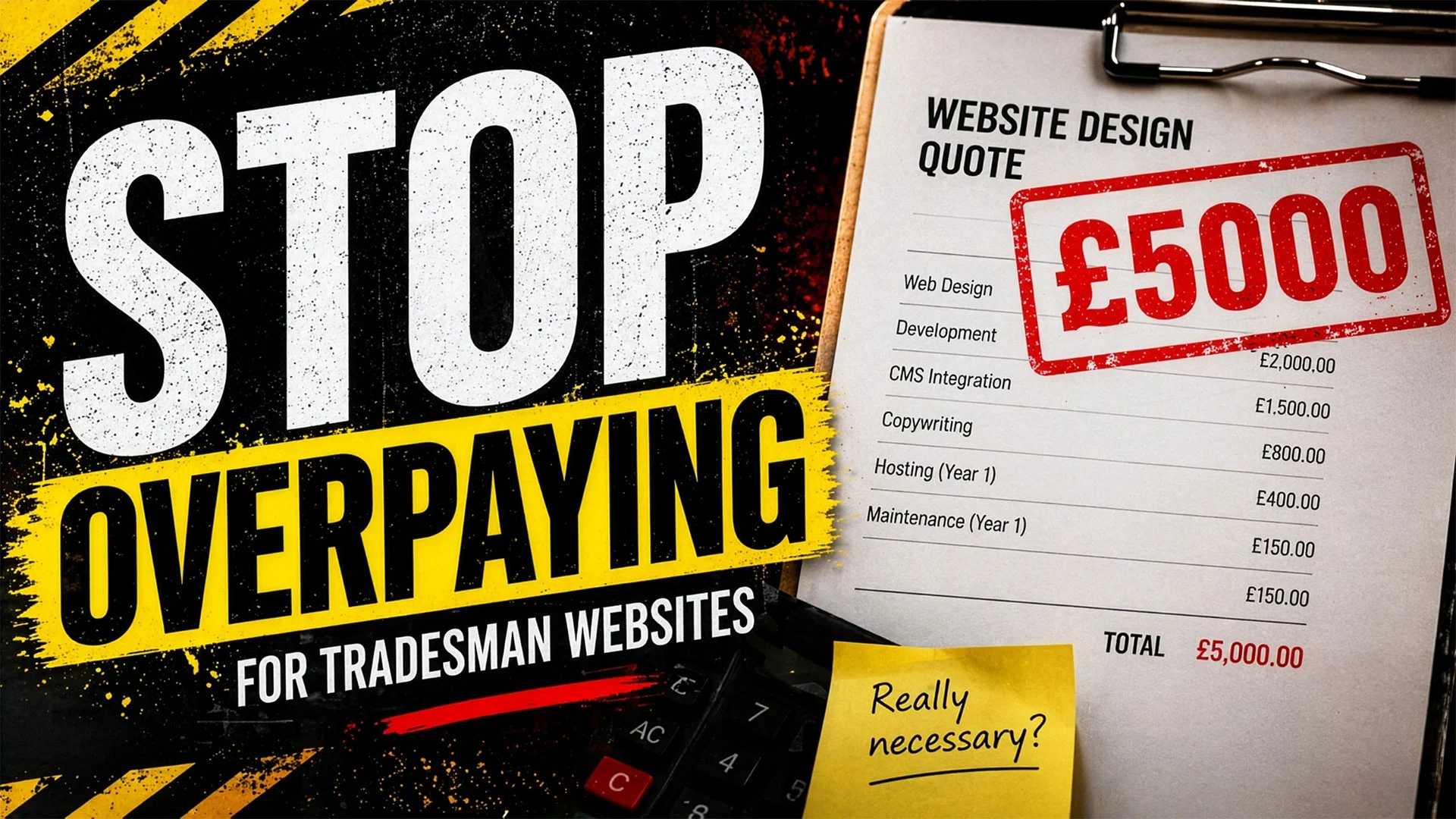
Quick answer. A tradesman website in the UK costs anywhere from £20/month forever (DIY platforms like Wix) to £6,000 (agency one-off build). I build them for £297 (Starter) and £797 (Professional) — one-off payment, you own everything.
Over three years that’s £657–£1,157 with my builds, vs £3,600 on Checkatrade where you own nothing at the end. The full breakdown by route, the maths, and the trap most pricing articles won’t mention are below.
Already know you want a one-off build?
Skip the maths. See what £297 actually gets you.
Want the comparison?
Six pricing routes, three-year totals, what you own at the end. The chart is just below.
Veon Media says a tradesman website costs £1,000 to £3,000. WDSEO starts at £1,600. Wix tells you it’s £20 a month. Checkatrade says you don’t need a website at all, just pay them £100 a month forever.
I build websites for tradesmen that stay in budget and I’ve been doing it for over ten years.
Here is what every tradesman website actually costs in 2026, by route, with the small print most articles leave out.
If you’re a plumber, electrician, builder or any kind of tradesperson looking at getting a website, you’ve probably Googled this exact question and ended up more confused than when you started.
That’s because most of the answers out there are written by agencies trying to justify charging you three grand, or by subscription platforms trying to lock you into £50 a month forever. Neither is giving you the full picture because both of them are selling you something.
I’m selling something too, so let me be upfront about that. I build websites for tradespeople in Kingston and South West London. I’ve been doing it for over ten years. But the reason I’m writing this is that the information out there is genuinely terrible, and I think tradespeople deserve a straight answer from someone who actually understands both the marketing theory and the technical delivery behind why a website works.
So here it is.
If you want to skip the pricing breakdown and go straight to the evidence, I’ve also audited 350 tradesman websites in South London and published the findings. And if you want the argument for why your website is a reflection of your craft, not just a marketing tool, read this.
What a tradesman website actually costs in 2026
Let’s skip the waffle and get to the numbers.
DIY builders (Wix, Squarespace, GoDaddy): £10 to £25 per month. Sounds cheap until you realise that’s £120 to £300 a year, every year, forever. And you’re building the thing yourself. If you value your time at even £20 an hour and it takes you 20 hours to figure out Wix (and it will, because you’re a plumber, not a web designer), you’ve already spent £400 in invisible labour before you’ve published a single page.
The real kicker: if you ever want to leave Wix, you can’t take your website with you. The whole thing lives on their platform. You’re renting, not owning. (Just like some of your worst customers!)
Monthly subscription web designers: £49 to £100 per month. Companies like Trades Web Design and We Build Stores will build you a site and charge you monthly. That’s £588 to £1,200 a year. After two years you’ve spent over a grand and you still don’t own anything. Stop paying and it disappears, same as Wix.
Agencies: £1,500 to £6,000. This is where most “how much does a website cost” articles are trying to steer you, because this is where the big margins live. A Birmingham agency called Veon Media says a “professionally built” tradesman website costs £1,000 to £3,000. A Plymouth company called WDSEO starts at £1,600. For a 5 page brochure site for a local plumber, these prices are hard to justify. You’re paying for their office, their project manager, their designer, their developer, and their account executive. None of those people are fitting your boiler.
One-off freelancers: £300 to £1,500. This is where I sit. A site from me starts at £297 for a Starter build and £797 for the Professional tier. One-off payment. You own the domain, the hosting, the content, everything. No monthly lock-in, no contracts. I can price it this way because I’m one person working from home, I’ve built hundreds of these sites, and I don’t have overheads to pass on.
The cost comparison nobody wants you to see
Here’s where it gets uncomfortable for the subscription guys and the directory platforms.
| Option | Year 1 | Year 2 | Year 3 | Total (3 years) | What you own |
|---|---|---|---|---|---|
| Checkatrade membership | £1,200 | £1,200 | £1,200 | £3,600 | Nothing |
| Monthly website subscription (£49/mo) | £588 | £588 | £588 | £1,764 | Nothing |
| Wix + your time (20 hrs × £20) | £700 | £300 | £300 | £1,300 | Nothing (platform locked) |
| Agency one-off build (£2,500 + £30/mo hosting) | £2,860 | £360 | £360 | £3,580 | The website |
| My Starter build (£297 + £10/mo hosting) | £417 | £120 | £120 | £657 | The website |
| My Professional build (£797 + £10/mo hosting) | £917 | £120 | £120 | £1,157 | The website |
vs £3,600 on Checkatrade in the same window — where you own nothing at the end. Same money, different outcome.
Read that last row again. £657 to £1,157 over three years and you own a professional WordPress website outright. Compare that to £3,600 on Checkatrade where you own absolutely nothing.
In marketing, there’s a concept called Customer Acquisition Cost, basically what you spend to win each new customer. Most tradespeople have never calculated theirs, but it’s the single most important number in your business after your day rate. If you’re paying Checkatrade £1,200 a year and getting 20 jobs from it, your CAC is £60 per customer. If a £297 website brings in 12 jobs in its first year (one per month, which is conservative), your CAC drops to about £25 per customer. And that number only gets better over time because the website keeps working for you without additional spend.
The Zero Moment of Truth: why word of mouth isn’t enough anymore
“I get all my work from word of mouth.”
This is the number one thing tradespeople say to me, and honestly, it’s fair. Word of mouth is the best marketing channel there is. No argument. If you’re fully booked three months out from referrals alone, a website probably isn’t urgent.
But here’s what’s changed. Google coined a term back in 2011 called the “Zero Moment of Truth,” and it describes something that’s become the defining behaviour of modern consumers. The idea is simple: before a customer makes any purchasing decision, they research it online first. Not sometimes. Virtually every time.
In practice, this is what it looks like for a tradesperson. Your mate Dave recommends you to his neighbour. Ten years ago, the neighbour would have just phoned you. Today, she picks up her phone and Googles your business name first. This is the Zero Moment of Truth: the gap between hearing about you and deciding to contact you.
If she finds a proper website with your services, your area, photos of your work and reviews, she calls you. The recommendation turned into a booking. The customer journey went from awareness (Dave’s recommendation) to consideration (Googling you) to decision (your website sealed it) to action (she picked up the phone). Textbook conversion funnel, happening in about 90 seconds on a smartphone.
If she finds nothing, or a Facebook page last updated in 2023, or a Checkatrade profile where you’re listed next to three competitors, the certainty wobbles. That frictionless journey just hit a wall. Maybe she checks one of those other plumbers who does have a website. Maybe she doesn’t call you at all.
A website doesn’t replace word of mouth. It completes the customer journey that word of mouth starts. Every tradesperson who’s told me “I don’t need a website” and then got one has said the same thing afterwards: “I didn’t realise how many people were Googling me.”
The Checkatrade trap
Most tradespeople I speak to are spending £1,500 to £2,300 a year across Checkatrade and MyBuilder combined without even thinking of it as a marketing cost. That money buys you a profile on someone else’s platform, where your reviews sit next to your direct competitors and customers are encouraged to get three quotes for every job.
The core problem is ownership. When you stop paying, everything disappears. Your reviews, your profile, your visibility. Years of reputation, gone overnight. In digital marketing, this is called “digital sharecropping,” building on land you don’t own.
I’ve written a full breakdown of Checkatrade vs owning your own website, including the sunk cost trap that keeps tradespeople paying even when the ROI doesn’t justify it, and the price hikes that come with zero negotiation. If you’re currently on Checkatrade, that article is worth 10 minutes of your time.
The smartest approach is using both: Checkatrade for lead volume, your own website for direct enquiries and credibility. But long-term, the website is the asset. Everything else is rent.
Why a Facebook page isn’t a website (and the algorithm doesn’t care about your kitchen install)
No, a Facebook page can’t replace a website. And I say this as someone who uses Facebook for my own business.
The marketing concept that explains why is called “mental availability,” coined by Professor Byron Sharp in his book “How Brands Grow.” The idea is that the brands people buy are simply the brands they can think of and find when they need something. Mental availability means being easy to think of. Physical availability means being easy to find.
When someone searches “plumber Kingston” on Google, they’re at the highest possible point of intent. They need a plumber, right now, in Kingston. That’s a customer actively looking to spend money. Google shows them websites, Maps listings, and directory profiles. Not Facebook pages. Facebook pages almost never appear in Google search results. So at the exact moment a potential customer is trying to find you, Facebook makes you invisible. Your physical availability is zero.
Then there’s the algorithm problem. The average Facebook business page reaches about 2 to 5% of its followers organically. Facebook deliberately throttles business page reach to push you toward paying for ads. If you have 500 followers and post a photo of your latest bathroom refit, roughly 15 people see it. That’s not a marketing strategy, that’s shouting into a void.
A Facebook page alongside a website is a solid combination, Facebook for showing off your work, website for being findable when it matters. A Facebook page instead of a website means you don’t exist at the precise moment your next customer is looking for you. For a full platform-by-platform breakdown covering Facebook, Instagram, TikTok, and more, read our dedicated analysis.
What I actually see wrong with tradesman websites (and it’s worse than you think)
When I audited 350 tradesman websites across Kingston, Sutton, and South London, I found that only 1 in 5 was genuinely functional. 47 were broken in ways that actively prevent customers from making contact. An electrician’s CTA button sends visitors to a jet washing company. A plumber’s site displays “THIS DOMAIN IS FOR SALE.” A builder’s footer reads “fffffggg.” These are real, live businesses with hundreds of five-star reviews. The full findings, with the marketing theory explaining why each problem matters, are in the complete audit report.
Here are the most common patterns I found across those 350 sites:
Contact forms that don’t work. A roofer in New Malden with 114 Checkatrade reviews has a callback form on his website with no submit button. Customers can type their details in, but nothing sends. That’s not friction, that’s a brick wall. He has no idea how many enquiries he’s been losing.
Placeholder text still on the homepage. An electrician with over 700 reviews has “Your Heading” still showing in his services section. The web designer who built the site left template placeholder text in and nobody ever noticed. In copywriting, the first five words a visitor reads determine whether they stay or leave. If those words are “Your Heading,” they leave.
Test credentials visible to the public. A painter and decorator’s site in Wimbledon has “filler@godaddy.com” showing as the login prompt. The GoDaddy test account was never replaced with real credentials. This is the web equivalent of leaving the scaffolding up after the job’s done.
Broken SSL certificates. A builder’s site displays “Your connection is not private” when you visit. Chrome literally warns visitors away before they see the homepage. Google also actively demotes sites without valid SSL in search rankings. Every day this goes unfixed, the site drops further down.
Casino content injected into the code. One electrician’s site has hidden gambling links embedded in the HTML. The site’s been compromised at some point and nobody noticed. This is what happens when a cheap build doesn’t get maintained.
These aren’t rare edge cases. This is what a significant number of tradesman websites actually look like under the surface. And every one of these businesses is paying for Checkatrade on top, completely unaware that their website is actively undermining their credibility.
What a good tradesman website actually needs
In design and user experience, there’s a principle called cognitive load theory. The idea is that the human brain can only process a limited amount of information at any one time. When a website throws too much at a visitor (too many menu items, too many calls to action, too many colours fighting for attention), the visitor’s brain gives up and they leave.
The best tradesman websites I’ve built are the simplest ones. Not because simple is lazy, but because simple is what converts. Here’s what actually matters.
A headline that says what you do and where. “Plumber in Kingston upon Thames” beats any clever tagline. This is what Google reads first, and it determines whether you show up in local searches. In SEO, this is called “search intent alignment,” matching your content to what people actually type into Google.
Your phone number, big, clickable, right at the top. The majority of Google searches now happen on mobile, with 71% of all search traffic coming from mobile devices (SQ Magazine, 2026). If someone has to scroll to find your number, they’ll call whoever made it easy. The psychology here is simple: reducing the number of steps between “I need a plumber” and “I’ve called one” directly increases your conversion rate.
Photos of your actual work. Not stock images. Real photos of real jobs. In Robert Cialdini’s work on influence and persuasion, he identifies “social proof” as one of the six fundamental principles that drive human decision-making. Your job photos are social proof. Stock images are the opposite, they’re a signal that you have nothing real to show. Customers can spot them instantly and trust evaporates.
Your reviews, front and centre. If you’ve got 200 five-star reviews on Checkatrade, those should be on a site you own, not buried on a platform that charges you £100 a month to access them. Reviews are the most powerful form of social proof available to a local business. Having them on your own website means customers see them before Checkatrade shows them your competitors.
A contact form that actually works. Test it yourself. Fill it in and check the email arrives. Every broken form is a customer who wanted to hire you and couldn’t.
SSL certificate (the padlock). No padlock means “Not Secure” in the browser, which means Google demotes you and visitors bounce. This costs nothing to fix and is absolute baseline. A basic maintenance plan like WP Sentry keeps SSL, plugins, and backups handled monthly so the site stays in working order without you thinking about it.
A professional email address. If your website says “contact us at dave_plumber_1987@hotmail.co.uk,” you’re sending a signal about how seriously you take your digital presence. It’s the online equivalent of turning up to a quote in paint-stained joggers. A proper email (dave@davesplumbing.co.uk) costs about £5 a month and immediately elevates how professional you appear.
That’s the list. You don’t need animations, parallax scrolling, or chatbots. Simple wins because it removes cognitive load and lets the customer do the one thing you actually want them to do: call you. For a trade-specific breakdown, see 5 Things Every Plumber’s Website Needs.
The colour thing (yes, it matters more than you think)
Quick aside on something most web designers won’t explain to you: brand personality. The colours on your website aren’t aesthetic choices. They are positioning choices, and tradesmen tend to get them right on the van and wrong on the website.
Jennifer Aaker’s brand-personality research (Aaker, 1997, Journal of Marketing Research) maps brands across five dimensions: sincerity, excitement, competence, sophistication, ruggedness. For tradesmen, two of those matter. Competence: the sense that you know what you’re doing. Ruggedness: the sense that you do it on-site, in real conditions, and it lasts. Sincerity is one-dimensional. Excitement is gimmicky. Sophistication reads as agency-flavoured, the wrong signal entirely. Trade brands live in the ruggedness × competence quadrant.
The colours follow the position. Plumbers, electricians, locksmiths, bathroom fitters default to trusting blues for the competence half. British Gas, Pimlico Plumbers, every insurance company on TV, every electrical wholesaler. Blue says “I know what I am doing, you can rely on me, this works.” Scaffolders, demolition crews, civils default to worker-bee yellow and black for the ruggedness half. Hi-vis on site. Black-and-yellow tape on hazardous edges. Visibility under load. Hi-vis isn’t fashion. It is a brand-personality choice that tradesmen made before they knew the term.
Some trades land in both at once. Surveyors and project managers often use safety yellow with concrete grey. Emergency trades sometimes go red and black for urgency × ruggedness. Landscapers go green to signal natural materials and growth. The colour wasn’t picked from a Pinterest board. It was picked because it told the customer the truth about the work.
Where tradesman websites fail is by inheriting templates that pull the brand toward the wrong dimension. A “modern, minimalist” theme drags you toward sophistication, the agency coordinate, the wrong industry’s signal. A washed-out grey theme strips out ruggedness entirely. If your van is yellow and black and your website is white-on-cream Helvetica, the customer is reading two different brands. They will pick whichever one the friend recommended and forget the other.
The point isn’t that you need a colour theory degree before building a website. The point is that your website’s colours are making an argument about your business whether you chose them deliberately or not. Most template sites default to whatever colour the theme came with, which means your brand identity was decided by a random designer in another country who’s never heard of Kingston upon Thames. Match the website to the van. Design choices matter, even unconventional ones. And your website reflects your craft whether you intended it to or not.
Why pricing is all over the place
The web design industry has no standardised pricing. Unlike the trades, where a day rate is a day rate and materials cost what they cost, web design pricing is essentially made up.
An agency in Shoreditch will quote you £5,000 for a 5 page site because they’ve got rent, a team of six, and overheads that would make your eyes water. A freelancer in Shropshire might do the same job for £900. Someone like me will do it for £297 because I’ve built hundreds of WordPress sites, I know exactly what a tradesman needs, and I don’t have middlemen.
Seth Godin, one of the most respected marketing thinkers alive, has a concept he calls the “Purple Cow.” The idea is that in a field full of ordinary cows, a purple cow is the only one worth noticing. Most web design agencies for tradespeople are the same cow in different fields: same pricing, same templates, same monthly subscription model, same SEO promises. The purple cow in this market is radical simplicity: a fast, affordable, one-off build with no ongoing fees where you own everything. That’s not undercutting for the sake of it. It’s a fundamentally different business model.
Seth Godin himself cited LingsCars as the ultimate Purple Cow, a car leasing website so unconventional it turned over £40 million a year. The principle is the same at any scale: be remarkable enough that people talk about you.
My advice: don’t buy the cheapest option and don’t buy the most expensive one. Find someone who understands your trade, who you can actually phone, and who’ll hand you the keys to everything when it’s done.
The maths: how fast does it pay for itself?
Take a Kingston plumber on £400 average jobs. One extra customer in the first month from a website that didn’t exist before pays for the £297 build. A second pays for hosting until 2030. The third is profit. The fourth is a story they tell at the pub about how the website that “looked too cheap” turned into the best £297 they spent that year.
Run the same maths over twelve months. One extra job per month is £4,800 in revenue from a £297 investment. The marketing industry calls anything above 5x ROI “excellent.” This is 16x. It’s only achievable because the entry cost is small enough that one customer covers it and small enough that you stop counting.
Compare that to Checkatrade at £100 a month, where every lead is being shopped to two other tradesmen. Or paid Google Ads at £5 to £15 a click with no guarantee anyone phones. A direct enquiry from a customer who already chose you, because they read your website and decided you were the one, is worth more than three quote-comparison leads. The maths only looks like maths. The actual mechanic is “did the customer decide before they called?”
The honest answer
The actual question isn’t “how much should a tradesman website cost?” The actual question is “how much should I pay to own the most public-facing thing my business has?” The honest answer is £297. The lazy answer is £100 a month forever. Pick the one you’d advise a mate to pick.
If you wanted a number from this article and got eight, that’s because the question is bigger than the number. Most articles will sell you a price tier and pretend that’s the answer. The price tier is a function of who built it, what you own at the end, and whether the thing actually does its job. Get those three right and £297 covers it. Get any of them wrong and £6,000 doesn’t.
FAQ
How much does a tradesman website cost in the UK in 2026?
Between £20/month (DIY platforms like Wix) and £6,000 (agency one-off). Realistic options for most tradesmen: £297–£1,500 for a one-off freelance build, £49–£100/month for subscription web designers, £1,500+ for an agency. One-off is almost always cheaper over 3 years and you own the site.
Is Checkatrade cheaper than a website?
No. Checkatrade is roughly £100/month — £3,600 over 3 years — and you own nothing when you stop paying. A one-off £297 starter website + £10/month hosting is £657 over 3 years, and you own the site, the domain, and every customer enquiry that comes through it.
Are subscription tradesman websites worth it?
Rarely. Subscription web designers charge £49–£100/month. After 24 months you’ve paid £1,200–£2,400 and still don’t own the site — stop paying and it disappears. A one-off build for the same money buys you the site outright.
What’s the cheapest way to get a tradesman website that actually works?
A one-off build from a freelance developer, hosted on your own WordPress install. £297 buys a functional 5-page site; £797 buys a Professional tier with custom design and SEO foundations. Hosting is £10/month. Total year-one cost: £417–£917, and you own everything.
Why are agency tradesman websites so expensive?
Agencies charge £1,500–£6,000 because they have offices, designers, project managers, account executives and developers all on payroll. Their margins justify the price. For a 5-page brochure site for a local tradesman, those layers don’t add value the customer sees. Most of what an agency charges is overhead, not site quality.
Comments
How Much Does a UK Tradesman Website Cost in 2026?
Article Updated on April 30, 2026
Quick answer. A tradesman website in the UK costs anywhere from £20/month forever (DIY platforms like Wix) to £6,000 (agency one-off build). I build them for £297 (Starter) and £797 (Professional) — one-off payment, you own everything.
Over three years that’s £657–£1,157 with my builds, vs £3,600 on Checkatrade where you own nothing at the end. The full breakdown by route, the maths, and the trap most pricing articles won’t mention are below.
Already know you want a one-off build?
Skip the maths. See what £297 actually gets you.
Want the comparison?
Six pricing routes, three-year totals, what you own at the end. The chart is just below.
Veon Media says a tradesman website costs £1,000 to £3,000. WDSEO starts at £1,600. Wix tells you it’s £20 a month. Checkatrade says you don’t need a website at all, just pay them £100 a month forever.
I build websites for tradesmen that stay in budget and I’ve been doing it for over ten years.
Here is what every tradesman website actually costs in 2026, by route, with the small print most articles leave out.
If you’re a plumber, electrician, builder or any kind of tradesperson looking at getting a website, you’ve probably Googled this exact question and ended up more confused than when you started.
That’s because most of the answers out there are written by agencies trying to justify charging you three grand, or by subscription platforms trying to lock you into £50 a month forever. Neither is giving you the full picture because both of them are selling you something.
I’m selling something too, so let me be upfront about that. I build websites for tradespeople in Kingston and South West London. I’ve been doing it for over ten years. But the reason I’m writing this is that the information out there is genuinely terrible, and I think tradespeople deserve a straight answer from someone who actually understands both the marketing theory and the technical delivery behind why a website works.
So here it is.
If you want to skip the pricing breakdown and go straight to the evidence, I’ve also audited 350 tradesman websites in South London and published the findings. And if you want the argument for why your website is a reflection of your craft, not just a marketing tool, read this.
What a tradesman website actually costs in 2026
Let’s skip the waffle and get to the numbers.
DIY builders (Wix, Squarespace, GoDaddy): £10 to £25 per month. Sounds cheap until you realise that’s £120 to £300 a year, every year, forever. And you’re building the thing yourself. If you value your time at even £20 an hour and it takes you 20 hours to figure out Wix (and it will, because you’re a plumber, not a web designer), you’ve already spent £400 in invisible labour before you’ve published a single page.
The real kicker: if you ever want to leave Wix, you can’t take your website with you. The whole thing lives on their platform. You’re renting, not owning. (Just like some of your worst customers!)
Monthly subscription web designers: £49 to £100 per month. Companies like Trades Web Design and We Build Stores will build you a site and charge you monthly. That’s £588 to £1,200 a year. After two years you’ve spent over a grand and you still don’t own anything. Stop paying and it disappears, same as Wix.
Agencies: £1,500 to £6,000. This is where most “how much does a website cost” articles are trying to steer you, because this is where the big margins live. A Birmingham agency called Veon Media says a “professionally built” tradesman website costs £1,000 to £3,000. A Plymouth company called WDSEO starts at £1,600. For a 5 page brochure site for a local plumber, these prices are hard to justify. You’re paying for their office, their project manager, their designer, their developer, and their account executive. None of those people are fitting your boiler.
One-off freelancers: £300 to £1,500. This is where I sit. A site from me starts at £297 for a Starter build and £797 for the Professional tier. One-off payment. You own the domain, the hosting, the content, everything. No monthly lock-in, no contracts. I can price it this way because I’m one person working from home, I’ve built hundreds of these sites, and I don’t have overheads to pass on.
The cost comparison nobody wants you to see
Here’s where it gets uncomfortable for the subscription guys and the directory platforms.
| Option | Year 1 | Year 2 | Year 3 | Total (3 years) | What you own |
|---|---|---|---|---|---|
| Checkatrade membership | £1,200 | £1,200 | £1,200 | £3,600 | Nothing |
| Monthly website subscription (£49/mo) | £588 | £588 | £588 | £1,764 | Nothing |
| Wix + your time (20 hrs × £20) | £700 | £300 | £300 | £1,300 | Nothing (platform locked) |
| Agency one-off build (£2,500 + £30/mo hosting) | £2,860 | £360 | £360 | £3,580 | The website |
| My Starter build (£297 + £10/mo hosting) | £417 | £120 | £120 | £657 | The website |
| My Professional build (£797 + £10/mo hosting) | £917 | £120 | £120 | £1,157 | The website |
vs £3,600 on Checkatrade in the same window — where you own nothing at the end. Same money, different outcome.
Read that last row again. £657 to £1,157 over three years and you own a professional WordPress website outright. Compare that to £3,600 on Checkatrade where you own absolutely nothing.
In marketing, there’s a concept called Customer Acquisition Cost, basically what you spend to win each new customer. Most tradespeople have never calculated theirs, but it’s the single most important number in your business after your day rate. If you’re paying Checkatrade £1,200 a year and getting 20 jobs from it, your CAC is £60 per customer. If a £297 website brings in 12 jobs in its first year (one per month, which is conservative), your CAC drops to about £25 per customer. And that number only gets better over time because the website keeps working for you without additional spend.
The Zero Moment of Truth: why word of mouth isn’t enough anymore
“I get all my work from word of mouth.”
This is the number one thing tradespeople say to me, and honestly, it’s fair. Word of mouth is the best marketing channel there is. No argument. If you’re fully booked three months out from referrals alone, a website probably isn’t urgent.
But here’s what’s changed. Google coined a term back in 2011 called the “Zero Moment of Truth,” and it describes something that’s become the defining behaviour of modern consumers. The idea is simple: before a customer makes any purchasing decision, they research it online first. Not sometimes. Virtually every time.
In practice, this is what it looks like for a tradesperson. Your mate Dave recommends you to his neighbour. Ten years ago, the neighbour would have just phoned you. Today, she picks up her phone and Googles your business name first. This is the Zero Moment of Truth: the gap between hearing about you and deciding to contact you.
If she finds a proper website with your services, your area, photos of your work and reviews, she calls you. The recommendation turned into a booking. The customer journey went from awareness (Dave’s recommendation) to consideration (Googling you) to decision (your website sealed it) to action (she picked up the phone). Textbook conversion funnel, happening in about 90 seconds on a smartphone.
If she finds nothing, or a Facebook page last updated in 2023, or a Checkatrade profile where you’re listed next to three competitors, the certainty wobbles. That frictionless journey just hit a wall. Maybe she checks one of those other plumbers who does have a website. Maybe she doesn’t call you at all.
A website doesn’t replace word of mouth. It completes the customer journey that word of mouth starts. Every tradesperson who’s told me “I don’t need a website” and then got one has said the same thing afterwards: “I didn’t realise how many people were Googling me.”
The Checkatrade trap
Most tradespeople I speak to are spending £1,500 to £2,300 a year across Checkatrade and MyBuilder combined without even thinking of it as a marketing cost. That money buys you a profile on someone else’s platform, where your reviews sit next to your direct competitors and customers are encouraged to get three quotes for every job.
The core problem is ownership. When you stop paying, everything disappears. Your reviews, your profile, your visibility. Years of reputation, gone overnight. In digital marketing, this is called “digital sharecropping,” building on land you don’t own.
I’ve written a full breakdown of Checkatrade vs owning your own website, including the sunk cost trap that keeps tradespeople paying even when the ROI doesn’t justify it, and the price hikes that come with zero negotiation. If you’re currently on Checkatrade, that article is worth 10 minutes of your time.
The smartest approach is using both: Checkatrade for lead volume, your own website for direct enquiries and credibility. But long-term, the website is the asset. Everything else is rent.
Why a Facebook page isn’t a website (and the algorithm doesn’t care about your kitchen install)
No, a Facebook page can’t replace a website. And I say this as someone who uses Facebook for my own business.
The marketing concept that explains why is called “mental availability,” coined by Professor Byron Sharp in his book “How Brands Grow.” The idea is that the brands people buy are simply the brands they can think of and find when they need something. Mental availability means being easy to think of. Physical availability means being easy to find.
When someone searches “plumber Kingston” on Google, they’re at the highest possible point of intent. They need a plumber, right now, in Kingston. That’s a customer actively looking to spend money. Google shows them websites, Maps listings, and directory profiles. Not Facebook pages. Facebook pages almost never appear in Google search results. So at the exact moment a potential customer is trying to find you, Facebook makes you invisible. Your physical availability is zero.
Then there’s the algorithm problem. The average Facebook business page reaches about 2 to 5% of its followers organically. Facebook deliberately throttles business page reach to push you toward paying for ads. If you have 500 followers and post a photo of your latest bathroom refit, roughly 15 people see it. That’s not a marketing strategy, that’s shouting into a void.
A Facebook page alongside a website is a solid combination, Facebook for showing off your work, website for being findable when it matters. A Facebook page instead of a website means you don’t exist at the precise moment your next customer is looking for you. For a full platform-by-platform breakdown covering Facebook, Instagram, TikTok, and more, read our dedicated analysis.
What I actually see wrong with tradesman websites (and it’s worse than you think)
When I audited 350 tradesman websites across Kingston, Sutton, and South London, I found that only 1 in 5 was genuinely functional. 47 were broken in ways that actively prevent customers from making contact. An electrician’s CTA button sends visitors to a jet washing company. A plumber’s site displays “THIS DOMAIN IS FOR SALE.” A builder’s footer reads “fffffggg.” These are real, live businesses with hundreds of five-star reviews. The full findings, with the marketing theory explaining why each problem matters, are in the complete audit report.
Here are the most common patterns I found across those 350 sites:
Contact forms that don’t work. A roofer in New Malden with 114 Checkatrade reviews has a callback form on his website with no submit button. Customers can type their details in, but nothing sends. That’s not friction, that’s a brick wall. He has no idea how many enquiries he’s been losing.
Placeholder text still on the homepage. An electrician with over 700 reviews has “Your Heading” still showing in his services section. The web designer who built the site left template placeholder text in and nobody ever noticed. In copywriting, the first five words a visitor reads determine whether they stay or leave. If those words are “Your Heading,” they leave.
Test credentials visible to the public. A painter and decorator’s site in Wimbledon has “filler@godaddy.com” showing as the login prompt. The GoDaddy test account was never replaced with real credentials. This is the web equivalent of leaving the scaffolding up after the job’s done.
Broken SSL certificates. A builder’s site displays “Your connection is not private” when you visit. Chrome literally warns visitors away before they see the homepage. Google also actively demotes sites without valid SSL in search rankings. Every day this goes unfixed, the site drops further down.
Casino content injected into the code. One electrician’s site has hidden gambling links embedded in the HTML. The site’s been compromised at some point and nobody noticed. This is what happens when a cheap build doesn’t get maintained.
These aren’t rare edge cases. This is what a significant number of tradesman websites actually look like under the surface. And every one of these businesses is paying for Checkatrade on top, completely unaware that their website is actively undermining their credibility.
What a good tradesman website actually needs
In design and user experience, there’s a principle called cognitive load theory. The idea is that the human brain can only process a limited amount of information at any one time. When a website throws too much at a visitor (too many menu items, too many calls to action, too many colours fighting for attention), the visitor’s brain gives up and they leave.
The best tradesman websites I’ve built are the simplest ones. Not because simple is lazy, but because simple is what converts. Here’s what actually matters.
A headline that says what you do and where. “Plumber in Kingston upon Thames” beats any clever tagline. This is what Google reads first, and it determines whether you show up in local searches. In SEO, this is called “search intent alignment,” matching your content to what people actually type into Google.
Your phone number, big, clickable, right at the top. The majority of Google searches now happen on mobile, with 71% of all search traffic coming from mobile devices (SQ Magazine, 2026). If someone has to scroll to find your number, they’ll call whoever made it easy. The psychology here is simple: reducing the number of steps between “I need a plumber” and “I’ve called one” directly increases your conversion rate.
Photos of your actual work. Not stock images. Real photos of real jobs. In Robert Cialdini’s work on influence and persuasion, he identifies “social proof” as one of the six fundamental principles that drive human decision-making. Your job photos are social proof. Stock images are the opposite, they’re a signal that you have nothing real to show. Customers can spot them instantly and trust evaporates.
Your reviews, front and centre. If you’ve got 200 five-star reviews on Checkatrade, those should be on a site you own, not buried on a platform that charges you £100 a month to access them. Reviews are the most powerful form of social proof available to a local business. Having them on your own website means customers see them before Checkatrade shows them your competitors.
A contact form that actually works. Test it yourself. Fill it in and check the email arrives. Every broken form is a customer who wanted to hire you and couldn’t.
SSL certificate (the padlock). No padlock means “Not Secure” in the browser, which means Google demotes you and visitors bounce. This costs nothing to fix and is absolute baseline. A basic maintenance plan like WP Sentry keeps SSL, plugins, and backups handled monthly so the site stays in working order without you thinking about it.
A professional email address. If your website says “contact us at dave_plumber_1987@hotmail.co.uk,” you’re sending a signal about how seriously you take your digital presence. It’s the online equivalent of turning up to a quote in paint-stained joggers. A proper email (dave@davesplumbing.co.uk) costs about £5 a month and immediately elevates how professional you appear.
That’s the list. You don’t need animations, parallax scrolling, or chatbots. Simple wins because it removes cognitive load and lets the customer do the one thing you actually want them to do: call you. For a trade-specific breakdown, see 5 Things Every Plumber’s Website Needs.
The colour thing (yes, it matters more than you think)
Quick aside on something most web designers won’t explain to you: brand personality. The colours on your website aren’t aesthetic choices. They are positioning choices, and tradesmen tend to get them right on the van and wrong on the website.
Jennifer Aaker’s brand-personality research (Aaker, 1997, Journal of Marketing Research) maps brands across five dimensions: sincerity, excitement, competence, sophistication, ruggedness. For tradesmen, two of those matter. Competence: the sense that you know what you’re doing. Ruggedness: the sense that you do it on-site, in real conditions, and it lasts. Sincerity is one-dimensional. Excitement is gimmicky. Sophistication reads as agency-flavoured, the wrong signal entirely. Trade brands live in the ruggedness × competence quadrant.
The colours follow the position. Plumbers, electricians, locksmiths, bathroom fitters default to trusting blues for the competence half. British Gas, Pimlico Plumbers, every insurance company on TV, every electrical wholesaler. Blue says “I know what I am doing, you can rely on me, this works.” Scaffolders, demolition crews, civils default to worker-bee yellow and black for the ruggedness half. Hi-vis on site. Black-and-yellow tape on hazardous edges. Visibility under load. Hi-vis isn’t fashion. It is a brand-personality choice that tradesmen made before they knew the term.
Some trades land in both at once. Surveyors and project managers often use safety yellow with concrete grey. Emergency trades sometimes go red and black for urgency × ruggedness. Landscapers go green to signal natural materials and growth. The colour wasn’t picked from a Pinterest board. It was picked because it told the customer the truth about the work.
Where tradesman websites fail is by inheriting templates that pull the brand toward the wrong dimension. A “modern, minimalist” theme drags you toward sophistication, the agency coordinate, the wrong industry’s signal. A washed-out grey theme strips out ruggedness entirely. If your van is yellow and black and your website is white-on-cream Helvetica, the customer is reading two different brands. They will pick whichever one the friend recommended and forget the other.
The point isn’t that you need a colour theory degree before building a website. The point is that your website’s colours are making an argument about your business whether you chose them deliberately or not. Most template sites default to whatever colour the theme came with, which means your brand identity was decided by a random designer in another country who’s never heard of Kingston upon Thames. Match the website to the van. Design choices matter, even unconventional ones. And your website reflects your craft whether you intended it to or not.
Why pricing is all over the place
The web design industry has no standardised pricing. Unlike the trades, where a day rate is a day rate and materials cost what they cost, web design pricing is essentially made up.
An agency in Shoreditch will quote you £5,000 for a 5 page site because they’ve got rent, a team of six, and overheads that would make your eyes water. A freelancer in Shropshire might do the same job for £900. Someone like me will do it for £297 because I’ve built hundreds of WordPress sites, I know exactly what a tradesman needs, and I don’t have middlemen.
Seth Godin, one of the most respected marketing thinkers alive, has a concept he calls the “Purple Cow.” The idea is that in a field full of ordinary cows, a purple cow is the only one worth noticing. Most web design agencies for tradespeople are the same cow in different fields: same pricing, same templates, same monthly subscription model, same SEO promises. The purple cow in this market is radical simplicity: a fast, affordable, one-off build with no ongoing fees where you own everything. That’s not undercutting for the sake of it. It’s a fundamentally different business model.
Seth Godin himself cited LingsCars as the ultimate Purple Cow, a car leasing website so unconventional it turned over £40 million a year. The principle is the same at any scale: be remarkable enough that people talk about you.
My advice: don’t buy the cheapest option and don’t buy the most expensive one. Find someone who understands your trade, who you can actually phone, and who’ll hand you the keys to everything when it’s done.
The maths: how fast does it pay for itself?
Take a Kingston plumber on £400 average jobs. One extra customer in the first month from a website that didn’t exist before pays for the £297 build. A second pays for hosting until 2030. The third is profit. The fourth is a story they tell at the pub about how the website that “looked too cheap” turned into the best £297 they spent that year.
Run the same maths over twelve months. One extra job per month is £4,800 in revenue from a £297 investment. The marketing industry calls anything above 5x ROI “excellent.” This is 16x. It’s only achievable because the entry cost is small enough that one customer covers it and small enough that you stop counting.
Compare that to Checkatrade at £100 a month, where every lead is being shopped to two other tradesmen. Or paid Google Ads at £5 to £15 a click with no guarantee anyone phones. A direct enquiry from a customer who already chose you, because they read your website and decided you were the one, is worth more than three quote-comparison leads. The maths only looks like maths. The actual mechanic is “did the customer decide before they called?”
The honest answer
The actual question isn’t “how much should a tradesman website cost?” The actual question is “how much should I pay to own the most public-facing thing my business has?” The honest answer is £297. The lazy answer is £100 a month forever. Pick the one you’d advise a mate to pick.
If you wanted a number from this article and got eight, that’s because the question is bigger than the number. Most articles will sell you a price tier and pretend that’s the answer. The price tier is a function of who built it, what you own at the end, and whether the thing actually does its job. Get those three right and £297 covers it. Get any of them wrong and £6,000 doesn’t.
FAQ
How much does a tradesman website cost in the UK in 2026?
Between £20/month (DIY platforms like Wix) and £6,000 (agency one-off). Realistic options for most tradesmen: £297–£1,500 for a one-off freelance build, £49–£100/month for subscription web designers, £1,500+ for an agency. One-off is almost always cheaper over 3 years and you own the site.
Is Checkatrade cheaper than a website?
No. Checkatrade is roughly £100/month — £3,600 over 3 years — and you own nothing when you stop paying. A one-off £297 starter website + £10/month hosting is £657 over 3 years, and you own the site, the domain, and every customer enquiry that comes through it.
Are subscription tradesman websites worth it?
Rarely. Subscription web designers charge £49–£100/month. After 24 months you’ve paid £1,200–£2,400 and still don’t own the site — stop paying and it disappears. A one-off build for the same money buys you the site outright.
What’s the cheapest way to get a tradesman website that actually works?
A one-off build from a freelance developer, hosted on your own WordPress install. £297 buys a functional 5-page site; £797 buys a Professional tier with custom design and SEO foundations. Hosting is £10/month. Total year-one cost: £417–£917, and you own everything.
Why are agency tradesman websites so expensive?
Agencies charge £1,500–£6,000 because they have offices, designers, project managers, account executives and developers all on payroll. Their margins justify the price. For a 5-page brochure site for a local tradesman, those layers don’t add value the customer sees. Most of what an agency charges is overhead, not site quality.